The Kamakura Print Collection ・ 鎌倉プリント・コレクションへようこそ
Photogravure etchings by Peter Miller・ フォトグラビュール (銅版画技法)・日本語
About the Artist
Since 1992, Peter Miller has held more than 40 one-man exhibitions in venues ranging from a vacant store in Kamakura to a now-defunct gallery on New York's fashionable East Side. The Yokohama Museum has hosted an exhibition of Miller's work, as have galleries in London, Paris, Tokyo, Kochi, Niigata, Cologne, Washington DC, Houston, Seattle, Moscow, St Petersburg, Ekaterinburg, and Vladivostok. The oldest building in which his prints have been exhibited is the 13th-century Palazzo dei Consoli in Gubbio, Italy. Group exhibits with his prints have been held in the Musée Jenisch in Vevey, Switzerland, the Royal National Theater in London, the International Engraving Exhibition in Cremona, Italy, and the Lahti Triennial in Finland. Peter Miller's prints have been acquired for the permanent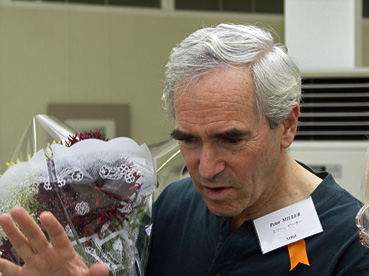 collections of Cleveland Museum of Art, National Museum of American Art, Fine Arts Museum of Houston, Bibliothèque Nationale de France, Victoria and Albert Museum, Kamakura Museum of Modern Art, several temples and shrines in Japan, and the Sackler Gallery of the Smithsonian where he is (with the exception of Whistler) the only American artist represented in a collection devoted to the art of Asia, the Asian Art Museum of San Francisco, and the National Oriental Museum of Russia.
Pittsburgh Pennsylvania in the 1950s, a gritty steel town at the confluence of three rivers with the Rust Belt and Appalachia, with its streetcars and inclines and bridges, its neighborhoods with onion-dome-topped churches, gave Miller his first glimpses of landscape. Something of his 'Iron City' origins remained in his blood, as many years later he took naturally to etching copper with ferric chloride, a rust-and-sangria-colored chemical.
Inspired by 19th-century photogravure etching, the 500-year intaglio tradition, Sung Dynasty ink paintings, and Japanese Zen minimalist aesthetics, Peter Miller is one of the few contemporary photogravure practitioners in the world performing the entire process from visualization to plate-making, etching, printing, and publishing. Photogravure is uniquely rich in texture, depth, and tonality, linking sight and touch in a way that connects the art-making experience directly with the art-viewing experience. In recognition of his accomplishments in the arts, he was elected a Member of the Cosmos Club in Washington DC in 2011.
The elements of intaglio -- ink, etching paper, and copperplate -- are simple, yet they enable the wonderfully tactile surfaces of oceans, clouds, rocks, temples, bamboo, and trees to come alive, each grain impressed into the fibers of hand-made etching paper. Closeup or far away, they stimulate a renewed sense of the variety of our visual world, a hint of the higher reality in our everyday lives.
Since 1991, he has published more than 330 editions of photogravure etchings, many of which are shown at this site.
Interview
World Printmakers interview at: https://www.worldprintmakers.com/english/news26.htm
Click on the link at: https://www.worldprintmakers.com/wrkshops/kamakura/kamakura.htm
"Peter Miller's gravure prints give us a world illuminated with myriad subtle mists and tones, somewhere between dreams and everyday reality. A fresh spontaneous spirit suffuses his work, free of any pretension. This deep appreciation of natural and simple things, seemingly lost to us Japanese, we can recover in Peter Miller's gravures. Equally impressive to me is his untiring dedication to rediscovering and practicing the long-lost art and craft of photogravure, ...making his prints all the more fascinating. Peter Miller's etchings reveal the essence of the ancient capital, Kamakura, with all the mystery and wonder found in its luminous mists and tones." -- Tadayasu Sakai, former Director of the Kamakura Museum of Modern Art
"When I saw Peter Miller's work for the first time, I was struck by its atmosphere which appeared to emerge straight from ancient Japan. Yet the landscapes realized through his own viewpoint are unmistakably those of today. He has revived the almost lost nineteenth-century technique of photogravure. The surface nuance of photogravure is a superb means of representing the misty atmosphere of Japan as it changes from season to season. This happy encounter between Peter Miller and Japan, and the resonant correspondence between technique and subject matter generated his original work." -- Kiyoko Sawatari, Associate Curator, Yokohama Museum of Art
Concentrated Serenity: Gravure Prints of Peter Miller. The gallery has been the site of numerous remarkable exhibitions, revealing to us the subtleties of the Japanese world vision, and its refined tradition through the work of Japanese artists in a variety of media. It has also exhibited the work of non-Japanese artists for whom Japanese art, culture, or imagery have played a significant part. In their art we find a fascinating blend of elements of both Eastern and Western influences. With the prints of Peter Miller, the outcome is one of surprising vigor and unexpected beauty that strikes off powerfully in new directions. A fascinating tangle of influences has brought Peter Miller to where he is today. A business trip as a consultant to Honda Motor Company first brought him to Japan in 1977, where he fell under the spell of the unique culture of the country and the beauty of its landscapes and mountains. Photography would not suffice; these images and the cultural nuances that surrounded them required, he felt, the texture of ink on paper. A 1989 exhibit of the photogravures of Peter Henry Emerson at New York's Metropolitan Museum of Art came as a revelation to Miller. He now knew the technique he needed to use. But the technique had long fallen out of use and Miller had to rediscover it for himself, mainly from out-of-date books. By 1991 he had acquired the equipment necessary to build a workshop in Kamakura and in 1992, after a year of experimentation, produced the first prints he felt were worth showing. The success of his efforts may be judged by the fact that he has exhibitions in major cities worldwide and that his prints have been acquired by the Arthur M Sackler Gallery of the Smithsonian Institution, the National Museum of American Art, the Cleveland Museum of Art, the New York Public Library, the Bibliothèque Nationale de France, and the Musée Jenisch of Switzerland. The 39 prints on view include a range of subjects. In Meigetsuin (1996) we gaze through the window of a tatami room to see an elegant and graceful pattern of branches outside. Hokokuji (1994) shows us a portion of a bamboo forest where the textures, shading, and linear features convey an almost abstract quality. In Snow Country a snow-covered temple nestles among towering conifers. And Potato Moons raises two humble potatoes to the level of a fine mezzotint. In all of these prints, the underlying aquatint process emerges, producing rich blacks and subtle gradations of gray. Peter Miller has presented us with a remarkable set of prints, expressed through a unique process, conveying Japanese imagery through the eyes of a Westerner who has been touched by the Japanese spirit. To explain his goal of expressing the 'minimal essence of things' through his gravure technique, Miller has quoted the Zen philsosphy in the famous garden of Ryoanji: 'Even if I have nothing, it is enough.' And yet, Miller's prints are far more than nothing, and one feels one has not had enough." -- Herbert Cooper, The Washington (DC) Print Club Quarterly
"The ancient city of Kamakura, with its temples, shrines and gardens, provides the material for much of Miller's art. Historically, Kamakura is associated with the emergence in late twelfth century Japan of zen, an approach to enlightenment centered on a constant awareness of the changing present moment, a series of practices which can be related to the art and craft of printmaking. In contrast with the sophistication of late Heian culture, in Kamakura the exponents of zen responded to harsher realities with a culture of rustic simplicity (wabi/sabi). The role of art was not to render visible some ideal image but rather through the chosen medium (usually ink on paper) to achieve reconciliation, tranquility, aesthetic fulfillment in an acceptance of the here and now. A similar philosophy achieved by applying a Western medium to an essentially Eastern experience lies behind Peter Miller's imagery. An essential component in Peter Miller's intaglio technique is the underlying presence of aquatint, which produces rich blacks and an atmospheric quality typical of Miller's work. In some prints snow and ice are dominant motifs, enveloping and transfiguring bridges, pavilions, ponds, hillsides. In others there are interior subjects in which rooms give on to graceful patterns formed from branches. Individual objects, a flower, a potato, a bulb of garlic, become the subject of mysterious and poetic still lifes. Distilled and transformed by the subtle chemistry of his chosen medium, each image, minuscule or monumental, becomes in Miller's hands a statement of his pleasure in ordinary objects and surroundings, a position expressed so succinctly in characters carved in stone at the zen temple of Ryoanji: ware shiru tada taru ('Even if I have nothing, it is enough')." -- Francis Kyle, Francis Kyle Gallery, London
"These quintessential Japanese images are, amazingly, created by American artist and Kamakura resident Peter Miller. Even more startling, given the nineteenth-century feel of the gravures, is that these are actually views of contemporary Japan. Miller's singular achievement is to cast the familiar in a different light, making us look closer. The bronze Daibutsu (Great Buddha), one of the way-stations on the tourist pilgrimage, in Miller's print made with sepia ink confounds our sense of time. Even with the figure of the little girl in her bonnet, the century in which this print was made seems uncertain. One of the most compelling images is Sandwaves, a rhythmic tour de force that sets the rippling parallels of the wind-carved sand against the vertical, man-made rhythms of the bamboo fence, the famous silhouette of Enoshima floating on the horizon under a luminous sky. In the alluring landscape Oze Path, which depicts an alpine marsh in central-northern Japan, the spatial effects of a receding linerar form ~ the weatherbeaten planks of a rustic path that wind through a gentle curve toward the distant hillside ~ are subtly complemented by tonal gradations and swirling clouds. Atmospheric light effects, not unlike those in a painting by Monet or one of the delicately toned Rembrandt etchings, are a hallmark of Miller's work, as in Oze Mist or Sai-no-Ko, which is also reminiscent of the lakeside paintings of Cezanne or Corot." -- Charles A Riley, II, PhD, Journal of the Print World
Comments from visitors to exhibits in Vladivostok, Russia:
'Is it possible to balance the span of human life against the images made during that life? I think it may be possible, but only when everything seen and unseen come into balance. That is when the unseen gives birth to what appears in the world. Let it be so! I'd like to keep looking at these prints through all my life.'
'Oh, how every moment is enveloped in eternity and from there a window is opened into your world. Under the endless sky and before this blue expanse, the world you have never been to becomes your fate as if in a dream.'
'The artist has a very interesting view of eternal nature. A human view, it is very beautiful, delicate, and highly professional. And the composition! -- it's a masterpiece.'
'It's wonderful, subtle, and modern.'
'What a great impression your works have made on me! It seems they exist on the border of Europe and Asia, between now and then, between Zen and Christianity. Your works express something huge and irresistible with great significance.'
'Your wonderful works enhanced my own recollected experiences of the places I've been -- Norway, France, Japan... Your prints reveal another side of these countries -- with a sacred atmosphere, with a great power of a sea and a sky...'
-- Translation by Irina Kirilenko
Video: interview on Vladivostok-TV, at Artetage Museum of Modern Art.
'Your works made me feel the harmony of the world!'
'It is so unusual. They are modern works but they look like 100-200 years old. They give the feeling of eternity and connect different times. My favorite one: Running, unlimited optimism.'
'It feels like you are in the 17th century.'
'I just was wondering why all the works have uneven edges'
'I liked the boy running on the beach. The sea makes waves but he is free from everything'
'It feels like Zen, previously I thought it was impossible to express eternity on paper.'
-- Translation by Valeria Kouzmenko
'I very much liked the photograph which I would call "Ship-Ghost". The large cargo ship looks as if it's transparent, and it seems that it, like a spirit, will disappear in the blanket of fog.' -- Vladimir
'The [works] don't jump at you at once; but with close examination, they surround you with that evenness/fairness, calmness, mastery, and aesthetics to which we all aspire so much. My soul was touched.' -- Tatyana
-- Translation by Pavel Bogomiakov
Photogravure etchings by Peter Miller in Museum and Temple Collections
Arthur M Sackler Gallery, Smithsonian Institution, Washington DC
National Museum of American Art, Washington DC
Gilkey Center for Graphic Arts, Portland Art Museum, Portland, Oregon
New York Public Library, Fifth Avenue and 42nd Street, New York, NY
Cleveland Museum of Art, 11150 East Boulevard, Cleveland, Ohio
Robert Hull Fleming Museum of the University of Vermont, Burlington, Vermont
Museum of Modern Art, Hayama, Japan / 神奈川県近代美術館
Jomyoji Temple, Kamakura
Hokokuji Temple, Kamakura
Tokeiji Temple, Kamakura
Victoria & Albert Museum, London, England
Bibliothèque Nationale de France, Paris, France
Musée Jenisch, Cabinet des Estampes, Vevey, Switzerland
Book and magazine covers
Site: Home・ホーム; Viewing・見聞; Learning・情報; Purchasing・ご注文; News ・ ニユース; Videos・ビデオ Xpress
Series: Temples・寺; Dreamscapes・夢; Seascapes・海; Furusato・ふるさと; Pathways・道; Mongolia・モンゴル; Acts & Scenes・町; Unseen・見残す; New Prints・新
Galleries where photogravure etchings by Peter Miller are available:
Baltimore: Conrad R Graeber Fine Art, Box 264, Riderwood, Md, U.S.A., tel +1-410-377-6713
San Francisco: Japonesque, 824 Montgomery Street, SF, Ca, U.S.A., tel +1-415 391-8860
Netherlands: Eric van den Ing, Saru Gallery, tel: +31(0)6-2246-4074.
Moscow: Lumiere Brothers Center, 119072, Red October, Bolotnaya emb 3 b. 1, Moscow, Russia, 119072), tel +7-968-451-4019
Vladivostok: Arka Gallery, 5 Svetlanskaya St, Vladivostok, Russia, tel +7-4232-410-526
 into your email (日本語 OK).